
Indicator 1: Fiber Material—PE or PP?
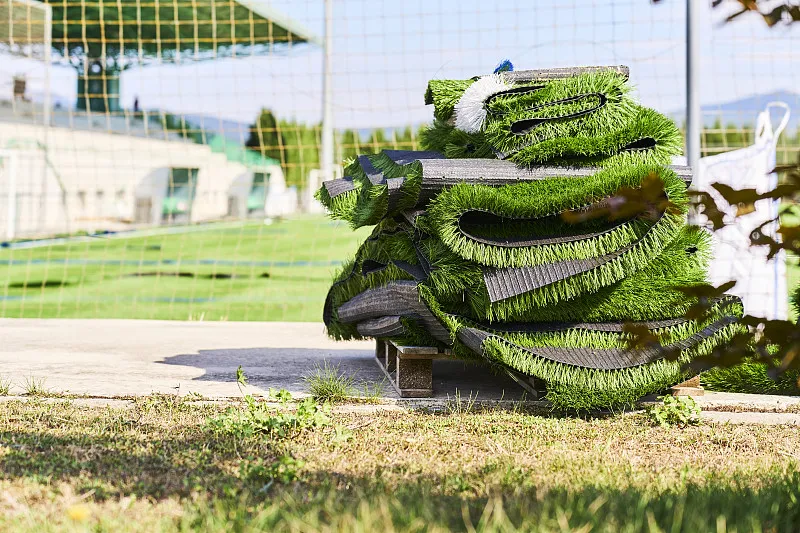
Mainstream football turf is currently made from polyethylene (PE); it offers a soft feel and excellent wear resistance, making it suitable for high-frequency use. While polypropylene (PP) is stiffer and holds its shape well, it lacks resilience and is typically used for landscaping or low-traffic areas. Pure PE is the preferred choice for football pitches.
Recommended Specifications:
Pile height: 50mm–60mm (standard for 11-a-side pitches)
Fiber weight (DTEX): 8,800–12,000 (higher values indicate better wear resistance)
Indicator 2: Density and Gauge
Turf density determines the pitch’s evenness and durability. Taking a standard 1/2-inch gauge with 160–180 stitches per meter as an example, the tuft count should be at least 10,500 stitches per square meter. For 5-a-side or indoor pitches, a density exceeding 12,600 stitches is recommended to withstand frequent sudden stops and changes of direction.
Indicator 3: Backing and Drainage
High-quality turf features a dual-layer backing structure—combining styrene-butadiene (SBR) latex with a PP mesh fabric—to ensure fibers remain securely anchored. For outdoor pitches, drainage performance is critical; high-quality turf has a backing perforation rate of 8–12%. When paired with a crushed-stone base layer, this allows for a drainage rate exceeding 30mm per minute, enabling the pitch to be ready for use just 30 minutes after rainfall. Tips to Avoid Pitfalls:
Beware of “low-price packages”—football turf priced below 25 RMB per square meter often suffers from significantly reduced fiber weight and density, resulting in a lifespan of less than two years.
Request third-party test reports, paying close attention to wear resistance (Lisport test), UV aging resistance, and heavy metal content.
Clearly define warranty terms in the contract; reputable manufacturers typically offer a 5–8 year warranty on football turf.
Choosing the right turf is not merely a one-time investment; it is a safeguard for the facility’s operation over the next 5 to 8 years.